An introduction to Canada

Canada is the second-largest country in the world with a total area of almost 10 million km2, but with a population of only 40 million (2026).
History
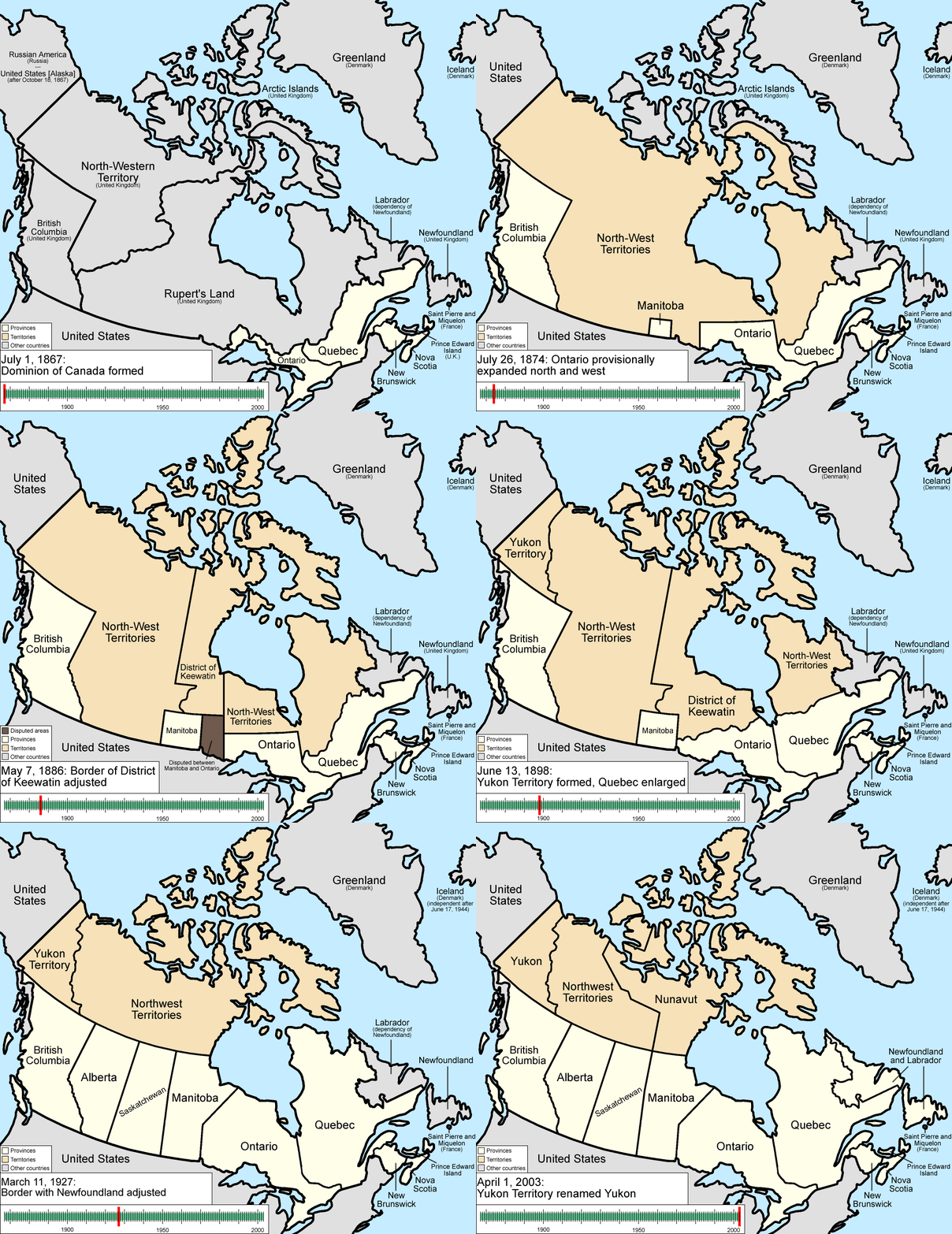
The land occupied by Canada was inhabited for millennia by various groups of aboriginal people. Beginning in the late 15th century, British and French expeditions explored, and later settled, along the Atlantic coast. France ceded nearly all of its colonies in North America in 1763, after the Seven Years' War. In 1867, with the union of three British North American colonies through Confederation, Canada was formed as a federal dominion of four provinces. It wasn’t until the signing of the Canada Act in 1982, that legal dependence on the British Parliament ended. Canada is a federation comprised of ten provinces and three territories. Here is an animation showing the evolution of Canadian provinces.
Geography

Mother Earth has been generous to the Canadians. Nature is a source of both recreation and financial income. Canada's mountains rise to almost 6,000 metres above sea level and as the country with the most inland, freshwater lakes, Canada has enough fresh water to turn the entire Sahara desert into a swamp.

Canada’s forests stretch for unimaginable distances providing employment and a secure income from timber export. Canadian farms produce beef, fruit and vegetables, and are the world’s number-one producer of wheat. With access to three oceans – the Arctic, the Atlantic and the Pacific – Canada ranks as one of the world’s biggest exporters of seafood such as fish, shrimp, crabs and lobster. Believe it or not – Canada even has its own production of high quality red and white wine! And who hasn't heard of Canada's world famous maple syrup?
Canada is the world's third-largest producer of natural gas and is a world leader in oil production, with much of its oil traditionally exported to its neighbour, the United States.
Did You Know?
Canada has the longest coastline in the world (243,000+ km) and over 50% of the world's natural lakes.
British Columbia has over 60 million hectares (149 million acres) of forest land. This is roughly the size of Germany and France combined.
- Baffin Island is almost as big as France.
- In 1947, the village of Snag in Yukon recorded the lowest temperature in North America, a chilling -63°C.
- The Trans-Canada Highway is one of the longest national highways in the world, stretching over 7,800 km.
Wildlife

Canada is so sparsely populated that the country's wildlife can enjoy an undisturbed natural habitat. Wildlife includes: black bears, grizzly bears, bison, raccoons, caribou, moose, bighorn sheep, wolves, musk ox, puma and lynx, not to mention the Arctic wildlife, of course! The many rivers and lakes provide for both recreational and sport fishing.
The Great White North
Much of Canada experiences very cold winters, with temperatures often dropping well below –20 °C, and in rare cases reaching extreme lows. That is probably why 90 % of the people live in the southermost parts of the country, close to the US border – the longest border in the world between two countries (8,892 km).
Famous People
The music of Drake, Celine Dion, Alanis Morissette, Bryan Adams, Justin Bieber, and Tate McRae is just some of what Canadians can be proud of. Actors such as Michael J. Fox, Keanu Reeves, Brendan Fraser, Ryan Reynolds, and Ryan Gosling are also Canadian. Actress Mary Pickford (1892-1979) was actually nick-named ”America´s Sweetheart” despite the fact that she came from Toronto. It is no wonder the Canadians tend to have a complex about their identity!
Canada Today
Canada is a parliamentary democracy and a constitutional monarchy, with King Charles III as its Head of State. It is a bilingual and multicultural country, with both English and French as official languages at the federal level.
Technologically advanced and industrialized, Canada maintains a diversified economy that is heavily reliant upon its abundant natural resources and upon trade—particularly with the United States, with which Canada has had a long and complex relationship. It is a member of the G8, NATO, the Commonwealth of Nations, the Francophonie, and the United Nations.
Research
- The USA is a country of 50 states but Canada is a country of provinces and territories. Using the internet, list Canada's provinces and territories and their capital cities. What is the name of the Canadian capital? Also, find out how many time zones the country crosses.
Canada has two official languages, English and French. Use the internet to find out how many people speak English and French as their first language, and where the majority of these speakers live.
Present
Use the internet to research and create a PowerPoint presentation about a famous Canadian. Possible search-words are: famous Canadians, Canadian writers, Canadian athletes, Canadian musicians, etc.
Relatert innhold
How would you describe Canada and Canadians?